Teardowns › Homepages & product pages › Identifiable victim effect
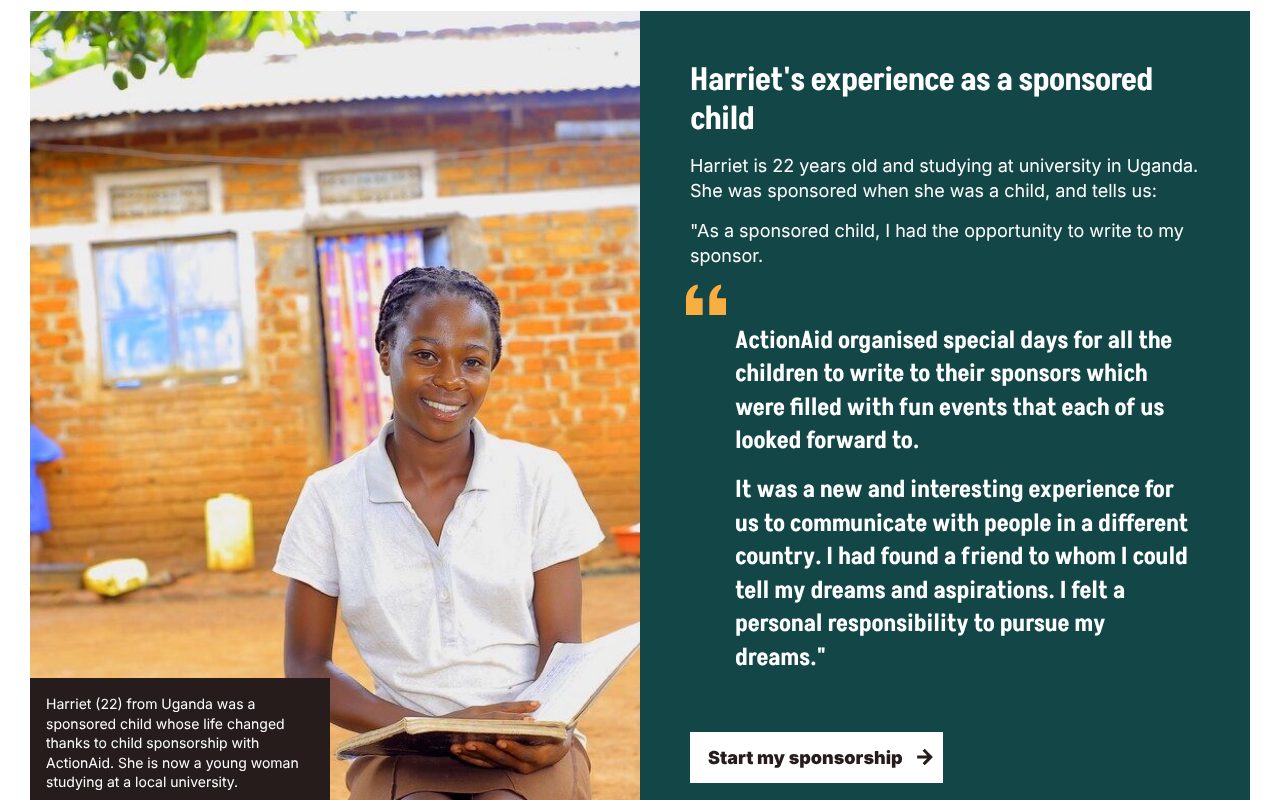
ActionAid sells community funding through one child, and shows Harriet
Lead with one real, named person, and credit the photo.
Step by step
- 1Identifiable victim effect
“Harriet is 22 years old and studying at university in Uganda.”
- 2Identifiable victim effect
“I felt a personal responsibility to pursue my dreams.”
Prices quoted in pounds (£), exactly as shown on the page we captured. Prices vary by region and change over time.
5 new nudges, every Friday
Five real product and marketing moments, one thing to try from each, and the psychology behind it. Weekly issues start soon. Your email is stored with our email provider (Resend) and used only for this newsletter.
What to steal
- Lead with one real, named person, and credit the photo.
- Put the money split on the same page as the story, as ActionAid does, so the single face does not hide where the money goes.
What to test next: Harriet’s story block vs a statistics block in the same place. Measure sponsorship starts and the share who read the money split.
In plain words
Why it works
ActionAid uses the identifiable victim effect: people give more to one named person than to a statistic (Small, Loewenstein & Slovic 2007). The page funds whole communities: “Child sponsorship costs just £19.50 a month and supports the work and action of a child’s entire community.” But the offer is framed through one child: a welcome pack “with a photo of the boy or girl you’re sponsoring”, and messages from them. The story block names one person: “Harriet is 22 years old and studying at university in Uganda.” Her quote ends “I felt a personal responsibility to pursue my dreams.” The same page says where the money goes: “80% of the donations we receive through child sponsorship goes overseas”, and of that, “70% goes directly to the community of the child you sponsor”. Whether Harriet’s story lifts sign-ups is not public.
Honest nudge or dark pattern?
Honest nudge
Honest nudge: the story is a real, named and credited person, and the page states that sponsorship funds the community, not the child alone, with the percentage split.
Sources: Captured by Nudgeswipe, 4 Nov 2026 (UK sponsor-a-child page, logged out)
Context
ActionAid UK sponsor-a-child page, logged out, on 4 Nov 2026. The photo is credited “Robert Asiimwe/ActionAid”. The page lists Ethiopia, India, Nepal, Rwanda, Sierra Leone and Zimbabwe as sponsorship countries.
The research
The research behind it
● Mixed evidence · More on identifiable victim effect, with sources →
Next: run it on your product
Try it on your own product
Opens your assistant with this teardown, our verdict and the steps above. It asks about your product first, then suggests tests you can run.
Read the prompt, or use another assistant
Grok and Cursor open with the prompt filled in. Gemini and Codex can’t take a prefilled link, so the prompt is copied and you paste it in.
Sources
- Our capture of actionaid.org.uk, 4 Nov 2026
- Small, Loewenstein & Slovic (2007), Sympathy and callousness: The impact of deliberative thought on donations to identifiable and statistical victims. doi.org/10.1016/j.obhdp.2006.01.005
- Captured by Nudgeswipe, 4 Nov 2026 (UK sponsor-a-child page, logged out): actionaid.org.uk
5 new nudges, every Friday
Five real product and marketing moments, one thing to try from each, and the psychology behind it. Weekly issues start soon. Your email is stored with our email provider (Resend) and used only for this newsletter.