Teardowns › Homepages & product pages › Sunk cost effect
Duolingo sends you back to units you’ve already completed
When you invite people back, name the work they have already finished.
Step by step
- 1Sunk cost effect
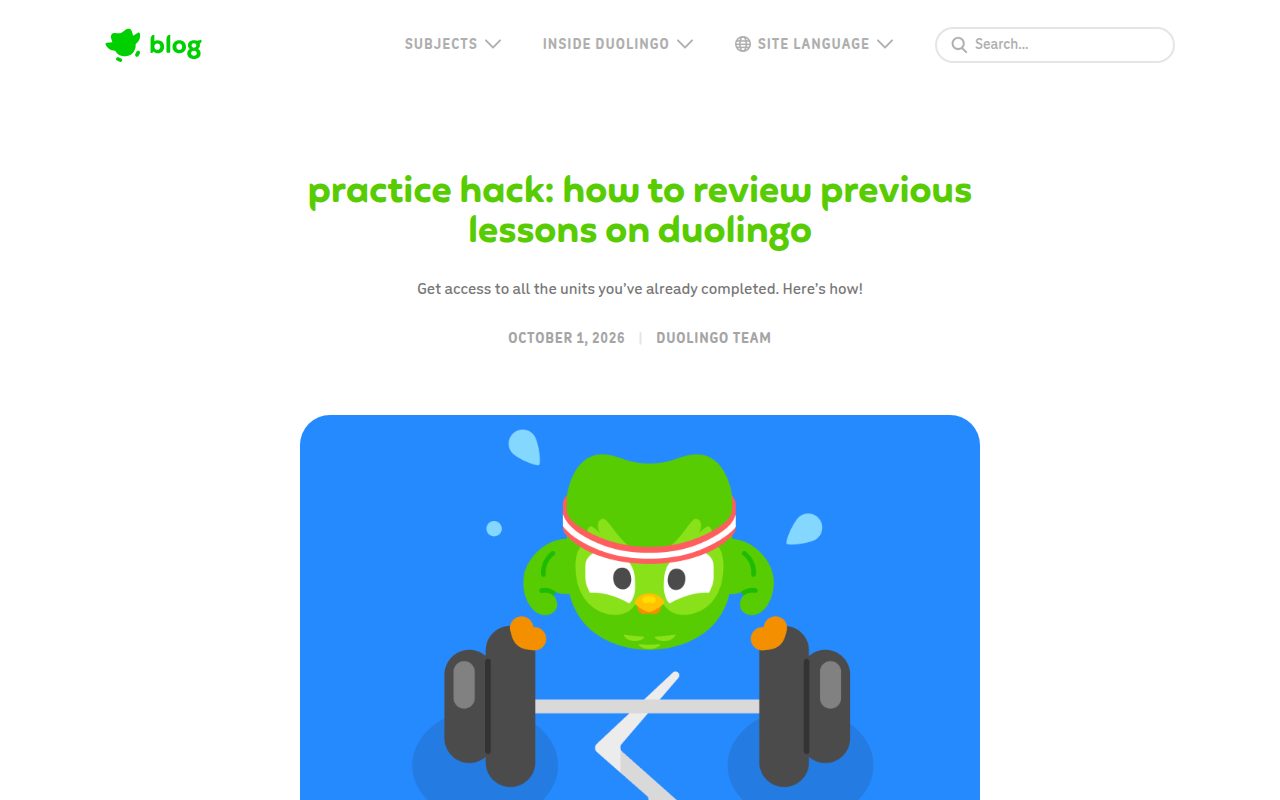
“practice hack: how to review previous lessons on duolingo”
- 2Sunk cost effect
“Get access to all the units you’ve already completed.”
5 new nudges, every Friday
Five real product and marketing moments, one thing to try from each, and the psychology behind it. Weekly issues start soon. Your email is stored with our email provider (Resend) and used only for this newsletter.
What to steal
- When you invite people back, name the work they have already finished.
- Show how to reopen it, and don’t threaten to wipe it.
What to test next: “Get access to all the units you’ve already completed” vs “Review any unit”. Measure how often people open an old unit.
In plain words
Why it works
Duolingo uses the sunk cost effect: people keep investing because of what they have already put in, not only what they will get next (Arkes & Blumer 1985). The headline is set in lowercase and reads “practice hack: how to review previous lessons on duolingo”. The line under it reads “Get access to all the units you’ve already completed. Here’s how!” The post is dated “OCTOBER 1, 2026” and credited “DUOLINGO TEAM”. It points at units already finished and says how to open them again. It does not say the units will be lost. Evidence for the effect is mixed. Whether this line brings people back to old units is not public.
Honest nudge or dark pattern?
Honest nudge
Honest nudge: the line describes access to work already done, and it does not list what you lose if you stop.
Sources: Captured by Nudgeswipe, 4 Nov 2026 (blog post, logged out)
Context
Duolingo blog post, logged out, on 4 Nov 2026. The date printed on the post is 1 October 2026. The picture under the byline is the owl lifting a barbell. This teardown does not treat the drawing as a claim.
The research
The research behind it
● Mixed evidence Why mixed: Real, but its size depends on context (Roth et al.; Friedman et al. 2007). · More on sunk cost effect, with sources →
Next: run it on your product
Try it on your own product
Opens your assistant with this teardown, our verdict and the steps above. It asks about your product first, then suggests tests you can run.
Read the prompt, or use another assistant
Grok and Cursor open with the prompt filled in. Gemini and Codex can’t take a prefilled link, so the prompt is copied and you paste it in.
Sources
- Our capture of blog.duolingo.com, 4 Nov 2026
- Arkes & Blumer (1985), The psychology of sunk cost. doi.org/10.1016/0749-5978(85)90049-4
- Captured by Nudgeswipe, 4 Nov 2026 (blog post, logged out): blog.duolingo.com
5 new nudges, every Friday
Five real product and marketing moments, one thing to try from each, and the psychology behind it. Weekly issues start soon. Your email is stored with our email provider (Resend) and used only for this newsletter.