Teardowns › Homepages & product pages › Negativity bias
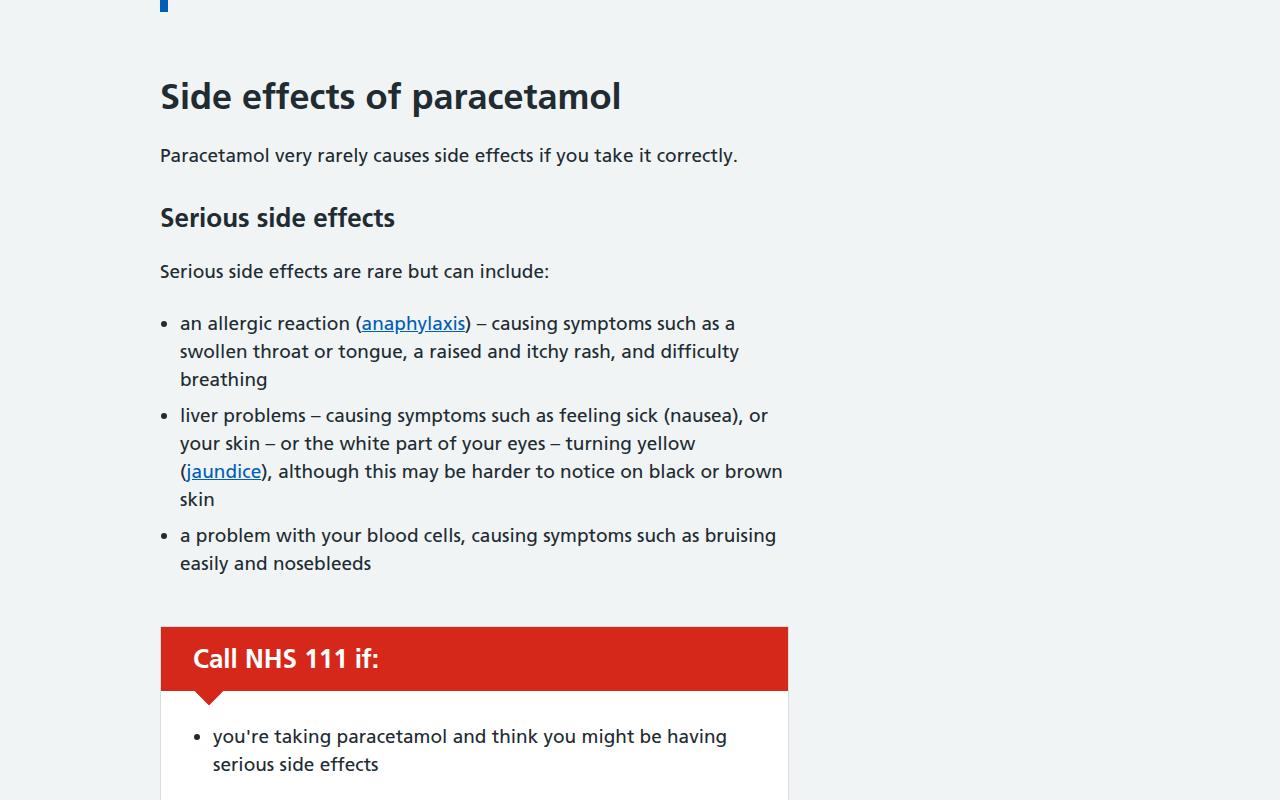
NHS gives serious paracetamol side effects their own heading
Give the serious harm its own heading, and say how rare it is in the same section.
Step by step
- 1Negativity bias
“Side effects of paracetamol”
- 2Negativity bias
“Serious side effects”
- 3Negativity bias
“Call NHS 111 if:”
5 new nudges, every Friday
Five real product and marketing moments, one thing to try from each, and the psychology behind it. Weekly issues start soon. Your email is stored with our email provider (Resend) and used only for this newsletter.
What to steal
- Give the serious harm its own heading, and say how rare it is in the same section.
- End the warning with what to do. This box says “Call NHS 111 if:”.
What to test next: This heading and red box vs the same facts in a single paragraph under “Side effects”. Measure whether people can name the NHS 111 step afterwards.
In plain words
Why it works
The NHS treats negativity bias as a reason to put the bad news where it will be seen: bad events weigh more than equally good ones (Baumeister et al. 2001). The heading is “Side effects of paracetamol”. Under it: “Paracetamol very rarely causes side effects if you take it correctly.” A second heading, “Serious side effects”, introduces “Serious side effects are rare but can include:” an allergic reaction (anaphylaxis), liver problems (jaundice), and a problem with blood cells. A red box says “Call NHS 111 if:” and “you’re taking paracetamol and think you might be having serious side effects”. The rare harms get a heading and a next step. Whether the box changes what people do is not public.
Honest nudge or dark pattern?
Honest nudge
Honest nudge: the page says serious effects are rare, names them in plain language, and says when to call NHS 111.
Sources: Captured by Nudgeswipe, 4 Nov 2026 (UK medicine page, logged out)
Context
NHS medicines page “Paracetamol for adults”, logged out, on 4 Nov 2026. This crop is the side-effects section. Common brands on the page, above this crop, include Panadol.
The research
The research behind it
● Strong evidence (provisional) · More on negativity bias, with sources →
Next: run it on your product
Try it on your own product
Opens your assistant with this teardown, our verdict and the steps above. It asks about your product first, then suggests tests you can run.
Read the prompt, or use another assistant
Grok and Cursor open with the prompt filled in. Gemini and Codex can’t take a prefilled link, so the prompt is copied and you paste it in.
Sources
- Our capture of nhs.uk, 4 Nov 2026
- Baumeister et al. (2001), Bad is Stronger than Good. doi.org/10.1037/1089-2680.5.4.323
- Captured by Nudgeswipe, 4 Nov 2026 (UK medicine page, logged out): nhs.uk
5 new nudges, every Friday
Five real product and marketing moments, one thing to try from each, and the psychology behind it. Weekly issues start soon. Your email is stored with our email provider (Resend) and used only for this newsletter.