Teardowns › Homepages & product pages › Regret aversion (risk reversal)
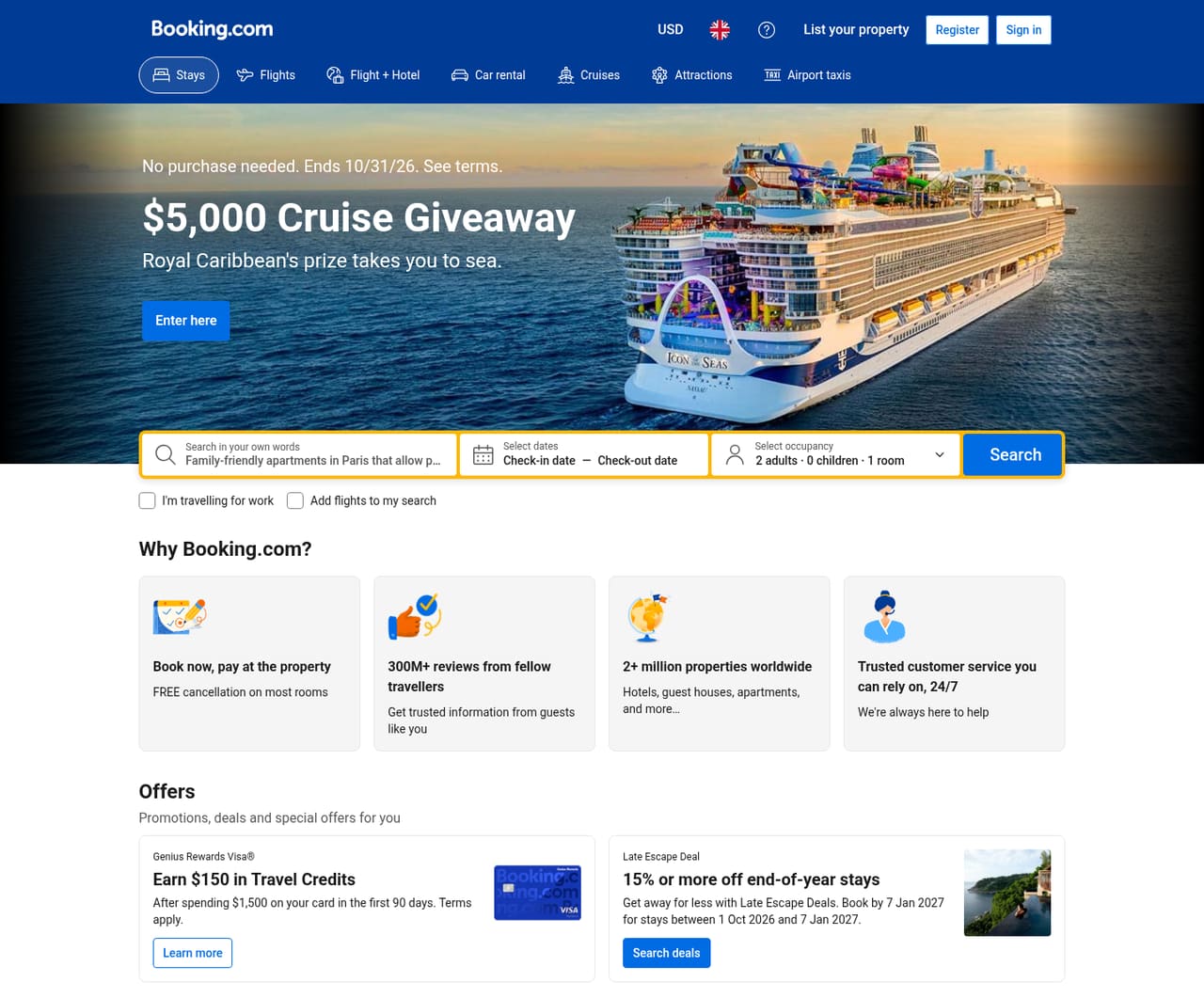
Booking.com answers "what if I change my mind?" before you search
Step by step
- 1Regret aversion
"Why Booking.com?" opens with "Book now, pay at the property" and "FREE cancellation on most rooms".
- 2Social proof
"300M+ reviews from fellow travellers" sits beside it.
- 3Urgency
An offer reads "Late Escape Deal: 15% or more off end-of-year stays… Book by 7 Jan 2027".
The psychology
Why it nudges
"Pay at the property" and free cancellation take away the fear of regretting a booking, so committing feels safe. The review count is social proof at scale. The dated Late Escape Deal adds a deadline, with a real end date shown. Whether these lift bookings for Booking.com is not public.
● Strong evidence · More on regret aversion (risk reversal), with sources →
Context
An online travel agency competing with hotels' own sites. Reassurance about changing plans is central to its pitch.
Honest nudge or dark pattern?
Honest nudge
Mostly honest: the deadline is dated and cancellation is real on "most rooms". Watch the word "most": the exceptions need to be just as clear at checkout.
Steal this, honestly
- Name the risk people fear and remove it in plain words, close to the main action.
- If you use a deadline, print the date.
What to test: Reassurance strip above vs below the search box. Measure searches started and bookings.
Next: run it on your product
Apply this with your agent
Take the steps above into your own flow. The prompt carries this teardown, the honest-vs-dark line and the steps.
ChatGPT, Claude, Grok and Cursor open with the prompt filled in (it is also copied, in case the prefill doesn't load). Gemini and Codex don't support prefilled links, so the prompt is copied and the app opens; paste it in.
Sources
- Our capture of booking.com, 16 Oct 2026
- Simonson (1992), The influence of anticipating regret and responsibility on purchase decisions. doi.org/10.1086/209290
Related teardowns

5 new nudges, every Friday
Five real product and marketing moments, the psychology behind each, and one thing to try. Weekly issues start soon. Your email is stored with our email provider (Resend) and used only for this newsletter.