Teardowns › Checkout & policies › Regret aversion (risk reversal)
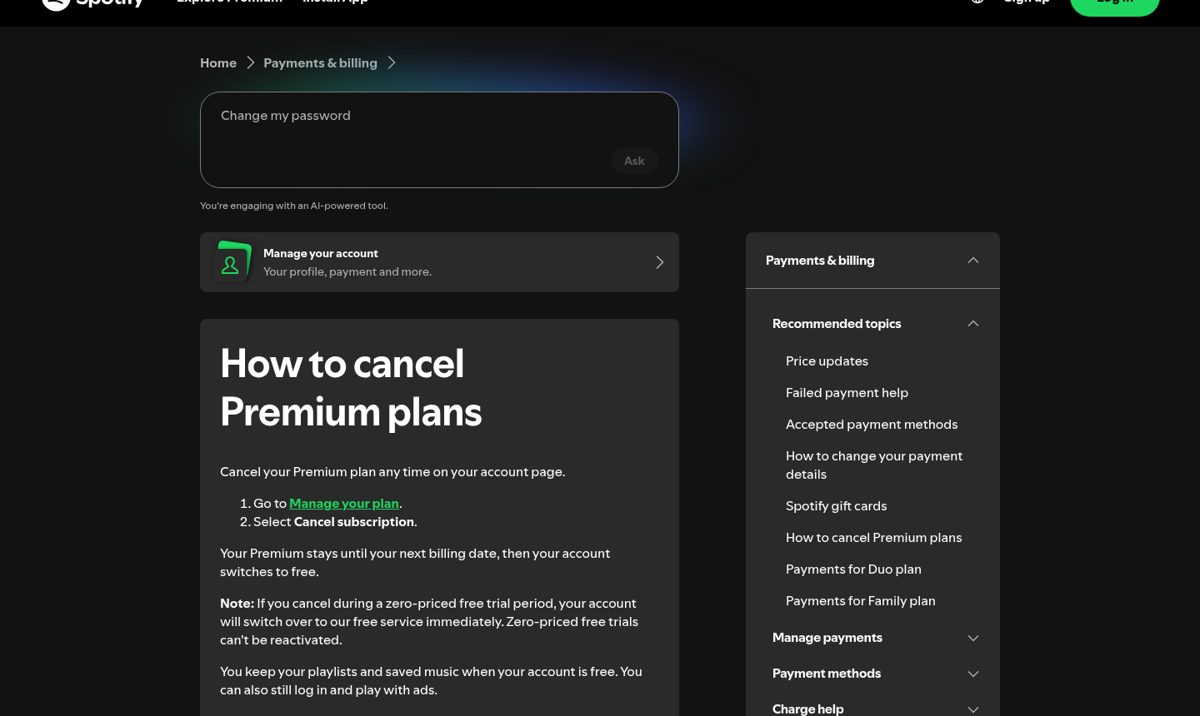
Spotify's cancel article says you keep your playlists
Step by step
- 1
"Cancel your Premium plan any time on your account page. Go to Manage your plan. Select Cancel subscription."
- 2
"Your Premium stays until your next billing date, then your account switches to free."
- 3
"You keep your playlists and saved music when your account is free." A note says zero-priced free trials end immediately and can't be reactivated.
The psychology
Why it nudges
Spotify documents that leavers keep their playlists and saved music, which reduces the loss people fear when cancelling (regret aversion). The endowment effect is why those playlists matter, not a retention hook here. Keeping Premium until the billing date makes cancelling feel less final. This is Spotify's documented policy, not a capture of the live flow. Results are not public.
● Strong evidence · More on regret aversion (risk reversal), with sources →
Context
Spotify's UK support article for cancelling Premium. A policy example: we did not capture the live cancel flow from a test account.
Honest nudge or dark pattern?
Honest nudge
Honest nudge: cancelling is straightforward and the reminder is true.
Steal this, honestly
- On your cancel page, say what users keep.
- Let paid access run to the end of the period.
- Spell out edge cases, such as trials ending immediately.
What to test: Cancel page with vs without the 'what you keep' line. Measure reactivation within 90 days.
Next: run it on your product
Apply this with your agent
Take the steps above into your own flow. The prompt carries this teardown, the honest-vs-dark line and the steps.
ChatGPT, Claude, Grok and Cursor open with the prompt filled in (it is also copied, in case the prefill doesn't load). Gemini and Codex don't support prefilled links, so the prompt is copied and the app opens; paste it in.
Sources
- Our capture of support.spotify.com, 16 Oct 2026
- Simonson (1992), The influence of anticipating regret and responsibility on purchase decisions. doi.org/10.1086/209290
Related teardowns
5 new nudges, every Friday
Five real product and marketing moments, the psychology behind each, and one thing to try. Weekly issues start soon. Your email is stored with our email provider (Resend) and used only for this newsletter.