Teardowns › Homepages & product pages › Authority
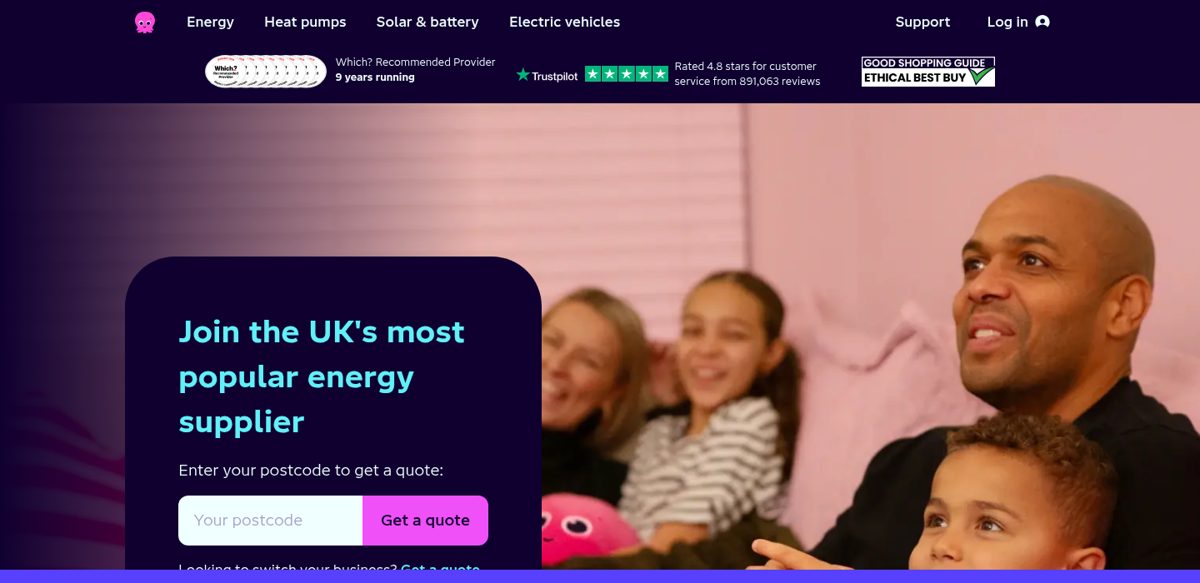
Octopus leads with Which? and 891,063 reviews
Step by step
- 1
A trust bar: "Which? Recommended Provider 9 years running".
- 2
"Rated 4.8 stars for customer service from 891,063 reviews".
- 3
Headline: "Join the UK's most popular energy supplier" with a postcode box: "Enter your postcode to get a quote".
The psychology
Why it nudges
Octopus uses authority (an independent consumer body's recommendation) and social proof (review count and 'most popular'), right next to a one-field quote form that keeps effort low. Results are not public.
● Strong evidence · More on authority, with sources →
Context
A UK energy supplier's homepage. Switching energy supplier is a low-trust, high-hassle decision for many households.
Honest nudge or dark pattern?
Conditional
Honest nudge if the claims are current and sourced. 'Most popular' needs a stated basis. Any "most popular" claim needs a stated basis.
Steal this, honestly
- Put independent third-party endorsements above your own claims.
- Use a specific review count rather than 'thousands'.
- Pair trust signals with a single, low-effort first step.
What to test: Trust bar above vs below the quote form. Measure quote starts.
Next: run it on your product
Apply this with your agent
Take the steps above into your own flow. The prompt carries this teardown, the honest-vs-dark line and the steps.
ChatGPT, Claude, Grok and Cursor open with the prompt filled in (it is also copied, in case the prefill doesn't load). Gemini and Codex don't support prefilled links, so the prompt is copied and the app opens; paste it in.
Sources
- Our capture of octopus.energy, 16 Oct 2026
- Milgram (1963), Behavioral study of obedience. doi.org/10.1037/h0040525
Related teardowns
5 new nudges, every Friday
Five real product and marketing moments, the psychology behind each, and one thing to try. Weekly issues start soon. Your email is stored with our email provider (Resend) and used only for this newsletter.