Teardowns › Pricing & paywalls › Price & attribute framing
The Economist prices a year by the week, and preselects it
Step by step
- 1
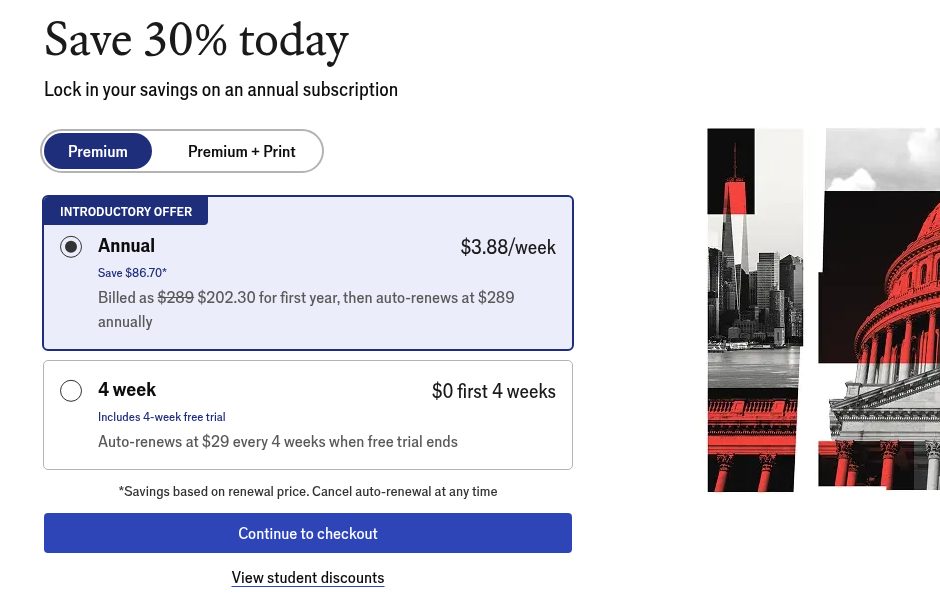
The annual plan is shown as "$3.88/week", not as an annual figure.
- 2
"Save $86.70*" sits under it; the asterisk says savings are based on the renewal price.
- 3
The real bill is shown in grey: "$289 $202.30 for first year, then auto-renews at $289 annually".
- 4
The Annual option is already selected; the alternative is "4 week: $0 first 4 weeks".
Prices quoted in dollars ($), exactly as shown on the page we captured (US-priced). Prices vary by region and change over time.
The psychology
Why it nudges
The Economist uses temporal price framing: restating a yearly price per week makes it feel smaller (the pennies-a-day effect). The struck-through $289 and "Save $86.70" give a reference price to judge the offer against. The preselected Annual radio adds a default: doing nothing means choosing the annual plan. Whether this lifts conversion for The Economist is not public.
● Strong evidence · More on price & attribute framing, with sources →
Context
A premium publisher selling to prospective subscribers on its own subscribe page. The page we saw showed US dollar prices. The annual introductory price is likely the plan it most wants new subscribers on, since it's both badged and preselected.
Honest nudge or dark pattern?
Honest nudge
Honest nudge as captured: the total, the renewal price and "Cancel auto-renewal at any time" are on the same screen. It would become a dark pattern if the total or renewal terms were hidden. See deceptive.design/hidden-subscription.
Steal this, honestly
- Restate an annual price in the unit people budget in (per week or per month), and keep the total visible on the same card.
- Show the reference price you're comparing against and say what it is ("based on renewal price").
- If you preselect a plan, preselect the one that suits most buyers and keep the alternative one click away.
What to test: Per-week vs annual-total headline price on the same plan. Measure paid conversions and 90-day refund or cancel rate, not just clicks.
Next: run it on your product
Apply this with your agent
Take the steps above into your own flow. The prompt carries this teardown, the honest-vs-dark line and the steps.
ChatGPT, Claude, Grok and Cursor open with the prompt filled in (it is also copied, in case the prefill doesn't load). Gemini and Codex don't support prefilled links, so the prompt is copied and the app opens; paste it in.
Sources
- Our capture of economist.com, 16 Oct 2026
- Tversky & Kahneman (1981), The framing of decisions. Pennies-a-day: Gourville (1998). doi.org/10.1126/science.7455683
- deceptive.design: hidden-subscription
Related teardowns
5 new nudges, every Friday
Five real product and marketing moments, the psychology behind each, and one thing to try. Weekly issues start soon. Your email is stored with our email provider (Resend) and used only for this newsletter.