Teardowns › Onboarding & retention › Choice overload (simplification)
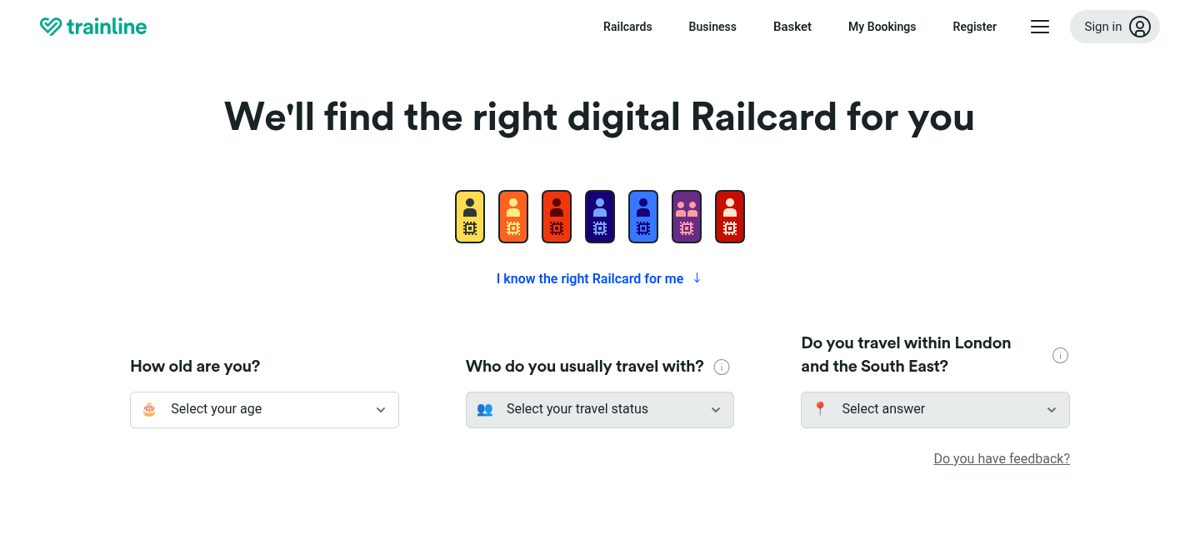
Trainline replaces a list of Railcards with three questions
Step by step
- 1
Headline: "We'll find the right digital Railcard for you".
- 2
Three dropdowns: "How old are you?", "Who do you usually travel with?", "Do you travel within London and the South East?"
- 3
An escape hatch for people who already know: "I know the right Railcard for me".
The psychology
Why it nudges
Trainline simplifies choice: the UK has many Railcards, and three questions narrow them to the right one, with an equal-weight route for people who already know. This also reduces the effort of comparing eligibility rules (friction). Choice-overload evidence is mixed, and results are not public.
● Mixed evidence (as used here) Meta-analysis: mean effect close to zero (Scheibehenne et al., 2010). · More on choice overload (simplification), with sources →
Context
A UK rail booking app selling digital Railcards, which come with eligibility rules by age, group and region.
Honest nudge or dark pattern?
Conditional
Conditional: honest only if the finder recommends the cheapest Railcard you're eligible for, not the one that earns Trainline most, and the "I know the right Railcard for me" route stays equal in weight. We haven't tested the finder's recommendations.
Steal this, honestly
- When customers must pick from many similar products, ask 2-3 questions instead of listing them.
- Offer a direct route for people who already know what they want.
- Use plain questions about the customer, not about product names.
What to test: Question-led finder vs product list. Measure purchase completion and wrong-card refunds.
Next: run it on your product
Apply this with your agent
Take the steps above into your own flow. The prompt carries this teardown, the honest-vs-dark line and the steps.
ChatGPT, Claude, Grok and Cursor open with the prompt filled in (it is also copied, in case the prefill doesn't load). Gemini and Codex don't support prefilled links, so the prompt is copied and the app opens; paste it in.
Sources
- Our capture of thetrainline.com, 16 Oct 2026
- Iyengar & Lepper (2000). Meta-analyses: Scheibehenne et al. (2010); Chernev et al. (2015). doi.org/10.1037/0022-3514.79.6.995
Related teardowns
5 new nudges, every Friday
Five real product and marketing moments, the psychology behind each, and one thing to try. Weekly issues start soon. Your email is stored with our email provider (Resend) and used only for this newsletter.