Teardowns › Homepages & product pages › Reason-giving ("because")
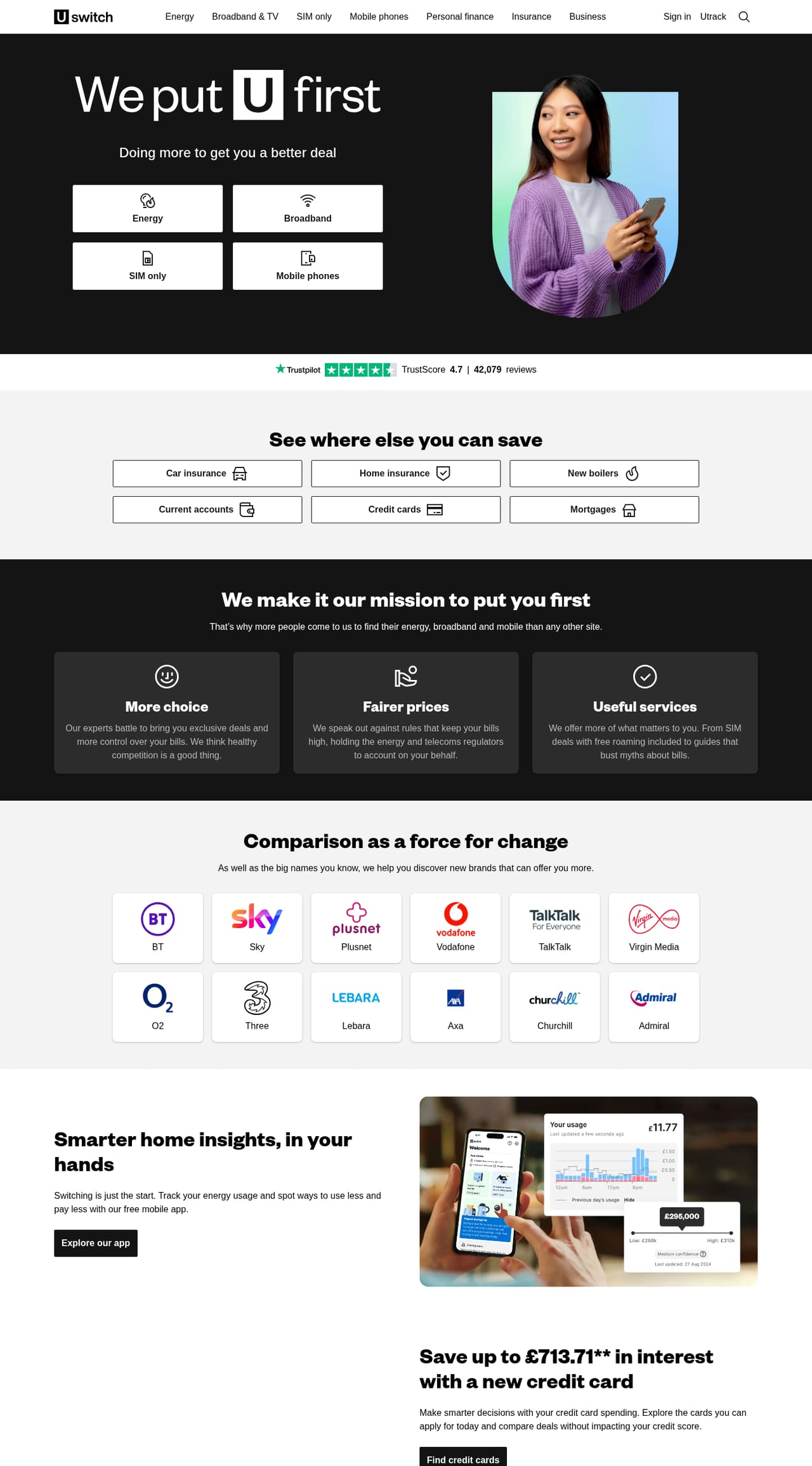
Uswitch gives its reasons ("That's why more people come to us") under a TrustScore
Step by step
- 1Social proof
"TrustScore 4.7 | 42,079 reviews" sits under the category tiles.
- 2Reason-giving
"We make it our mission to put you first. That’s why more people come to us to find their energy, broadband and mobile than any other site."
- 3Anchoring
"Save up to £713.71** in interest with a new credit card".
Prices quoted in pounds (£), exactly as shown on the page we captured. Prices vary by region and change over time.
The psychology
Why it nudges
Stating the reason ("that's why") gives a claim a rationale, which people often accept more readily (reason-giving). The review count is social proof, and a precise "up to" saving is an anchor. Whether these lift switching for Uswitch is not public.
Company claim: The TrustScore and "more people… than any other site" are the company's own claims, as shown on its page. We haven't verified them.
● Limited evidence · More on reason-giving ("because"), with sources →
Context
A UK comparison site for energy, broadband and mobile.
Honest nudge or dark pattern?
Conditional
Conditional: The basis of "more people… than any other site" is not shown on the page. Unsupported best-in-class claims and undated deadlines can't be called honest until checked.
Steal this, honestly
- Give the reason for a claim in plain words.
- Footnote what an "up to" saving is based on, and make the footnote easy to find.
What to test: Reason copy vs plain claim. Measure click-through to comparisons.
Next: run it on your product
Apply this with your agent
Take the steps above into your own flow. The prompt carries this teardown, the honest-vs-dark line and the steps.
ChatGPT, Claude, Grok and Cursor open with the prompt filled in (it is also copied, in case the prefill doesn't load). Gemini and Codex don't support prefilled links, so the prompt is copied and the app opens; paste it in.
Sources
- Our capture of uswitch.com, 16 Oct 2026
- Langer, Blank & Chanowitz (1978), The mindlessness of ostensibly thoughtful action: The role of "placebic" information in interpersonal interaction. doi.org/10.1037/0022-3514.36.6.635
- Captured by Nudgeswipe, 16 Oct 2026 (logged out): uswitch.com
Related teardowns
5 new nudges, every Friday
Five real product and marketing moments, the psychology behind each, and one thing to try. Weekly issues start soon. Your email is stored with our email provider (Resend) and used only for this newsletter.